
Magnet Calculator – Calculate Pull Force of Magnets
Use the magnet calculator to calculate the strength of a magnet. You enter the size of the magnet and the distance between the magnet and a metal surface. The magnet calculator then calculates how much force the magnet exerts on the metal at the given distance. If we have magnets with a strength close to the one you have calculated, we list them below. Be aware that the magnet calculator is not 100% accurate, but it gives a pretty good indication of the strength a magnet has at various distances from a metal surface.
.
.
What do pull force and strength mean?
Pull force is often simply called “strength” and indicates how many kilograms of force are required to pull the magnet away from a steel plate.
The difference between pull force and usable holding capacity
Pull force is the value most commonly used to describe how strong a magnet is. It measures the load applied during a direct pull. However, it is sometimes more relevant to consider how many kilograms the same magnet can support on a magnetic wall without sliding down. When the magnet is attached to a vertical wall, the load acts parallel to the surface. Its holding capacity therefore also depends on the friction between the magnet and the metal. As the load increases, the magnet will either slide down or tilt away from the wall. This is called the magnet’s holding capacity. Read more about this here. The magnet calculator returns the pull force, not the holding capacity.
How the distance between the magnet and the steel plate affects its strength
Any distance between the magnet and the steel plate to which it is attached will reduce the magnet’s strength. Even a gap of 0.5 mm significantly reduces the strength, and at a distance of 10 mm the magnet has lost most of its strength. Use the magnet calculator to see how much strength is lost at a particular distance. For general information about how distance affects a magnet’s performance, see this article on the subject.
Magnetisation direction
The magnet calculator assumes that the magnet’s north and south poles are located on its two flat faces. For block magnets, which have six faces, the poles are located on the two largest faces.
Assumed steel type, size and thickness
In practice, magnets are used with many types of iron and steel plates of different thicknesses. The magnet calculator does not account for these differences. The calculation model uses an idealised magnetic metal surface. The empirical calibration is based on physical tests against a 20 mm steel plate of a quality equivalent to S235JR. As long as the steel plate you use is at least 2 mm thick, the calculator’s results provide a useful starting point. The most important factor to consider is the type of metal being used. Metals such as aluminium, copper, brass and many types of stainless steel are not attracted to magnets.
Surface and pull-force assumptions
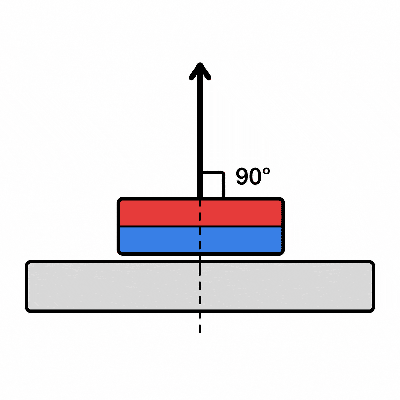
The magnet calculator assumes that the metal surface is clean and that there is full contact between the magnet and the metal. It also assumes that the pull force acts perpendicular to the metal surface and through the centre of the magnet.
The results are conservative
A magnet grade is specified using a range for its remanence (Br), rather than a single fixed value. The magnet calculator uses the lowest Br value in the range for the selected magnet grade instead of the range’s average value.
In addition, all calculated pull forces are multiplied by an empirical calibration factor. This factor was determined by comparing the model’s theoretical results with our physical pull-force measurements. Its purpose is to bring the calculated results closer to the measured values.
The result remains an estimate and may differ from the result of a physical pull test.
Variables not included in the magnet calculator
A physical pull test can account for variables that are not included in the magnet calculator. These include manufacturing tolerances, temperature, vibrations and rounded edges.
Expected margin of error
The result from the magnet calculator should be regarded as an estimate, and we cannot specify a guaranteed margin of error. When comparing the calculator’s results with physical tests, we typically observe a deviation of ±15%.
When is a physical pull test necessary?
The magnet calculator should be used as the first step in determining which magnet is suitable for a particular application. If the application allows for a large margin of error, the calculator may be sufficient. However, physical testing is necessary if there is little or no room for error, or if there is a risk of personal injury or property damage. The same applies when the magnet’s performance may be affected by parameters that the calculator cannot include. If you require a pull-force test, we will be happy to perform one. Order a test here.