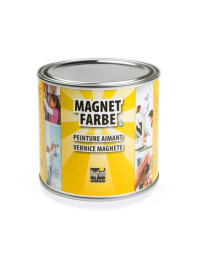
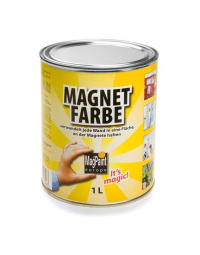
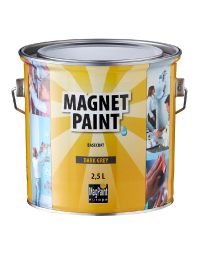
Magnetic paint is not magnetic, but magnets can stick to the dried paint. You can think of it as a metal plate that can just be painted on the wall.
Magnetic paint consists of two parts. One part is the paint. The other part is a large amount of fine iron powder that is mixed into the paint. You will therefore find that magnetic paint weighs significantly more than regular paint due to the large amount of iron powder. The iron powder allows magnets to stick once the paint has dried.
What types of magnetic paints are there?
Magnetic paint is sometimes used as a term for different types of paints, each of which is good for different things. To make it a little easier, we can divide them into three groups of paints:
- Magnetic paint: Works in conjunction with magnets and is used for organizing papers, pictures and the like. Similar to a whiteboard, but with the difference that you can't write with markers, crayons or anything else on magnetic paint.
- Whiteboard paint: Paint on which you can draw with markers just like on a whiteboard. Whiteboard paint does not work with magnets.
- Chalkboard paint: Paint on which you can draw with blackboard chalk, like the large blackboards in school classrooms. Chalkboard paint does not work with magnets.
There are different types of magnetic paint, each of which can do different things. Some types are for magnets, others are for magnets and can be written on with chalk or markers. However, the most common type is magnetic paint, which is only for magnets and cannot be written on. If you want to be able to write on the magnetic paint, it is possible. Just add an extra layer of special paint at the end. The different combinations can be simplified as follows:
Magnetic paint — overview of combinations
| Type of paint | Board magnets | Chalkboard chalk | Whiteboard markers | Color of choice |
|---|---|---|---|---|
| Magnetic paint | Yes | No | No | No (standard color only, typically gray or black) |
| Magnetic paint + finishing regular paint | Yes | No | No | Yes |
| Magnetic paint + chalkboard paint/board varnish | Yes | Yes | No | No (standard color only, typically gray or black) |
| Magnetic paint + whiteboard paint | Yes | No | Yes | Depends on the color of the whiteboard paint |
Explanation of each combination
Magnetic paint: Only magnetic paint is applied. The surface becomes magnetic but cannot be written on, and the color is limited to the standard shade (typically gray or black).
Magnetic paint + finishing regular paint: Magnetic paint is applied first, followed by a final coat of regular wall paint in the desired color. The surface is magnetic and can be painted in any color, but cannot be written on.
Magnetic paint + chalkboard paint/board varnish: Magnetic paint is applied first and finished with a layer of chalkboard paint. The result is a magnetic board that can be written on with chalk. The color is limited to the standard shade of the chalkboard paint (typically gray or black).
Magnetic paint + whiteboard paint: Magnetic paint is applied first and finished with a layer of whiteboard paint. The result is a magnetic board that can be written on with whiteboard markers. The color depends on the whiteboard paint used.
These are the most common combinations, but the possibilities are many. One important thing to remember is that magnetic paint works best with direct contact between magnetic paint and magnets. So if you're finishing with something else such as chalkboard paint, you should add an extra layer of magnetic paint so that the magnet has something to "bite into" when working through the chalkboard paint.
How much magnetic paint do I need?
Paint with at least two coats and preferably three coats. If you have more layers of magnetic paint, there is more iron powder for the magnets to stick to. If you only have 1 coat of magnetic paint, you will need very powerful magnets to make up for the lack of iron powder.
Expect half a liter of magnetic paint to cover 1 m2 with three coats.
Is magnetic paint an alternative to a whiteboard?
No, magnetic paint will not suffice if you want to replace a whiteboard. You can attach magnets to magnetic paint. If you also want to write on the magnetic paint with markers, finish with whiteboard paint. If you want to write with chalk, finish with chalkboard paint/chalkboard varnish.
What magnets can I use on magnetic paint?
Because magnetic paint is not 100% iron, but instead iron powder mixed with paint, you need magnets that are more powerful than those used for regular whiteboards. To find suitable magnets for magnetic paint, take a look at the product category "Magnets for glass boards". On each product page you can see how many pieces of A4 paper the magnet has been tested to hold up without sliding down. You can find the category by clicking here: Magnets for glass whiteboard
Is magnetic paint unhealthy?
As with any paint, you need to research what you're buying. The paints we sell are approved for sale in the EU and are therefore tested according to the EN71-3 standard. In short, this means that the paint is not harmful to children.
How do I remove magnetic paint?
If you've painted on an already painted wall, expect some work to remove the magnetic paint. It will either need to be sanded down with sandpaper or scraped off with a paint scraper. Both methods take some time and of course, the wall will need to be painted over when you're done.
If you've painted on wallpaper, you can scrape off the wallpaper and re-wallpaper.
You can also consider putting self-adhesive wallpaper/foil on the wall and then painting with the magnetic paint on top of it. When you no longer want the magnetic paint on the wall, simply peel off the self-adhesive wallpaper/foil and your wall should look the same as before. You do need to be a little careful with this method, as the magnetic paint is heavy and may not be held up by the self-adhesive wallpaper/foil. However, if you only want to paint a small area of the wall with magnetic paint, the self-adhesive wallpaper/foil can be a good solution.